Not Worth a Continental: 250 Years of American Money
There is an old American phrase, rarely heard anymore, for something utterly worthless: "not worth a continental." It is a fitting place to start a tour of American currency, because the nation's very first paper money was, by the end of its short life, exactly that — worthless. The story of how the dollar in your wallet got from there to here runs through war debt, two failed central banks, a civil war, a gold rush, a depression, and a single afternoon in 1971 that changed money forever.
Continentals: The First American Dollar, and Its Collapse
The First and Second Banks: Hamilton's Solution, and Its Undoing
Into that vacuum stepped Alexander Hamilton, Washington's Treasury Secretary, who believed the young nation needed a real financial institution to stabilize its credit and give it standing with European lenders. The First Bank of the United States, chartered in 1791 and modeled on the Bank of England, issued banknotes backed by gold and silver, took in tax revenue, and helped the federal government manage the debts left over from the Revolution. It worked reasonably well for twenty years, but Jeffersonian suspicion of concentrated financial power kept the political pressure on, and the Bank's charter was allowed to expire in 1811. A second attempt, the Second Bank of the United States, was chartered in 1816 and performed a similar stabilizing role for two more decades, until President Andrew Jackson, convinced the Bank concentrated dangerous power in the hands of wealthy financiers, killed it for good in 1836. What followed was the so-called free banking era: thousands of state-chartered banks, each printing its own notes, with no national standard for what any of it was actually worth. A traveler crossing two or three states might carry banknotes from a dozen different banks, several of them worthless without anyone realizing it until the bank had already failed.
Greenbacks, Gold, and the Long Road to a National Currency
The Federal Reserve and the End of Gold
The gold standard provided stability, but it could not prevent banking panics, and a particularly severe one in 1907 convinced Congress that the country needed a real central bank. The Federal Reserve Act of 1913 created the Federal Reserve System, a deliberately decentralized central bank with twelve regional banks rather than one institution concentrated in New York, in part to avoid the same political backlash that had killed Hamilton's bank a century before. For its first two decades, the Fed operated alongside the gold standard rather than replacing it; by law, Federal Reserve notes had to be backed by gold equal to 40 percent of their value. That arrangement could not survive the Great Depression. As panicked Americans hoarded gold and distrust of banks spread, President Roosevelt suspended the domestic gold standard in 1933, ordering citizens to turn in their gold coins and certificates in exchange for paper currency, a controversial move that nonetheless stabilized the banking system. The dollar remained loosely tied to gold internationally for decades longer, through the Bretton Woods system that pegged other world currencies to the dollar and the dollar to gold at $35 an ounce. That final link broke on a single weekend in August 1971, when President Nixon suspended the dollar's convertibility into gold altogether, ending the era of gold-backed American money for good and turning the dollar into the purely fiat currency it remains today — valuable not because it can be exchanged for a fixed quantity of metal, but because the government says so, and the world, by and large, still agrees.
The half-century since 1971 has been the longest stretch in American history without any link between the dollar and a fixed physical commodity, and it has reshaped the national conversation about money in ways the Founders never anticipated. Freed from the gold standard's discipline, the Federal Reserve gained far greater latitude to expand or contract the money supply in response to recessions, financial crises, and pandemics, a flexibility many economists credit with helping the country weather shocks like the 2008 financial crisis and the 2020 COVID downturn more effectively than the rigid gold-standard era ever allowed. That flexibility has a cost, however, and it shows up as inflation: a dollar in 2026 buys only a small fraction of what a dollar bought in 1971, a depreciation gold-standard advocates point to as proof that fiat currency inevitably erodes its own value over time, while defenders of the current system argue that some inflation is a manageable, even necessary, feature of a growing economy rather than a flaw.
The dollar's unusual position as the world's primary reserve currency has only added another layer to the debate. Because so much of global trade, lending, and central bank reserves are still denominated in dollars, the Federal Reserve's decisions ripple far beyond U.S. borders, giving America a degree of economic influence over the rest of the world that few other nations enjoy with their own currencies. That privilege has long made it easier and cheaper for the United States to borrow money, which brings the story back to a number that now dwarfs anything Hamilton or Jefferson could have imagined: a national debt exceeding the size of the entire American economy, financed in a currency the government can, in principle, print more of whenever it chooses. Whether that arrangement represents a uniquely American advantage or a uniquely American vulnerability is, in many ways, simply the latest chapter of the same argument this magazine traced back to its origin on page 5 and page 6 of this issue — the 250-year-old disagreement over how much power to entrust to a central financial authority, still being argued out today in Federal Reserve meetings, congressional debt ceiling fights, and the price tag on a gallon of milk.
Two hundred and fifty years after the first worthless Continental rolled off a colonial printing press, the American dollar has become the dominant reserve currency on Earth, backed by nothing more substantial than the full faith and credit of the United States government. The Founders who wrote a gold-and-silver clause into the Constitution specifically to prevent this outcome would likely be astonished. Whether they would also be reassured is a harder question, and very much a live one in modern economic debate — which is, in its way, simply the founding-era argument over money and federal power, still being argued out one Federal Reserve meeting at a time.
Sources
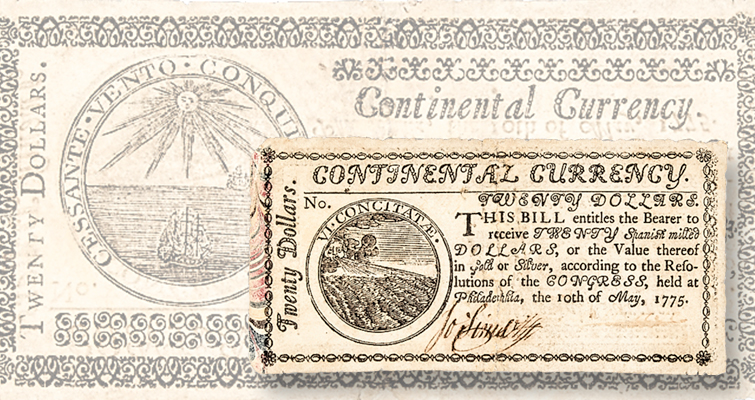 When the Continental Congress needed to finance the Revolutionary War, it did the only thing available to a government with no treasury and no taxing power over independent colonies: it printed money. Beginning in 1775, the Congress issued paper notes called Continental currency, denominated in dollars and backed by nothing more than a promise that future tax revenue would eventually redeem them. The states printed their own competing currencies on top of that, with no coordination between them. The results were predictable. As the war dragged on, Congress printed more and more Continentals to cover expenses, and British counterfeiters, by Benjamin Franklin's own account, flooded the colonies with fake notes specifically to accelerate the collapse. By 1781, Continentals had depreciated so badly they simply stopped circulating as money at all. The experience left the Founders deeply suspicious of paper currency, suspicious enough that the Constitution they wrote a few years later said nothing about the federal government's power to print paper money, and explicitly barred the states from making anything but gold or silver coin legal tender for debts.
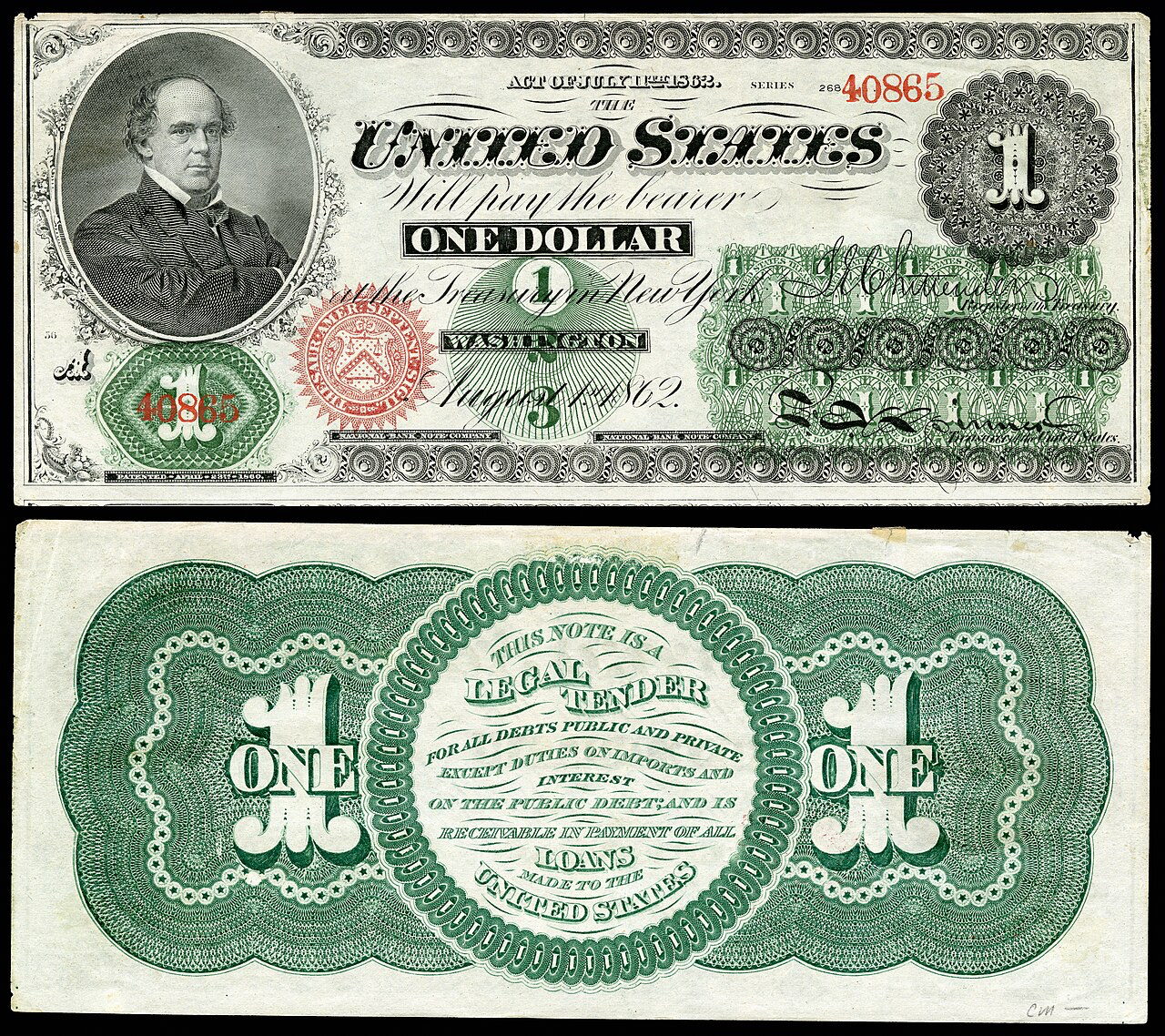 The Civil War finally forced the issue. With the Union desperate to finance the war effort and the chaotic state-bank system inadequate to the task, Congress authorized Demand Notes in 1861 and, the following year, the Legal Tender Act created United States Notes, printed with green ink on the back and known ever since as Greenbacks. Unlike earlier currency, Greenbacks were not backed by gold or silver; the government simply declared them legal tender by law, a genuinely radical step at the time. The National Banking Act of 1863 went further, creating federally chartered banks and a single national currency standard that finally swept away the patchwork of thousands of competing state banknotes. By the late 1800s, the country had settled into a gold standard, in which paper currency could be exchanged for a fixed amount of gold on demand, a system meant to anchor the dollar's value to something tangible and prevent the kind of runaway printing that had destroyed the Continental a century earlier.
 The Fiat Era: Inflation, Reserve Status, and the Debt Question
Federal Reserve History
Federal Reserve Bank of Minneapolis
American Numismatic Society
Library of Congress, Banking History Research Guide
Econlib
|
|||
| search engine by freefind |
Your ad could be in the next issue of idleguy.com for as little as $6 per month. Contact Fearless Rick using the form on page 15 for more information.
is the official online marketplace for idleguy.com and dtmagazine.com, featuring vintage magazines and other merchandise for sale.