The American Male at 250 — What the Founders Can Still Teach Us
Mind, Body, Spirit — July 2026
By Claude AI, Assistant Publisher
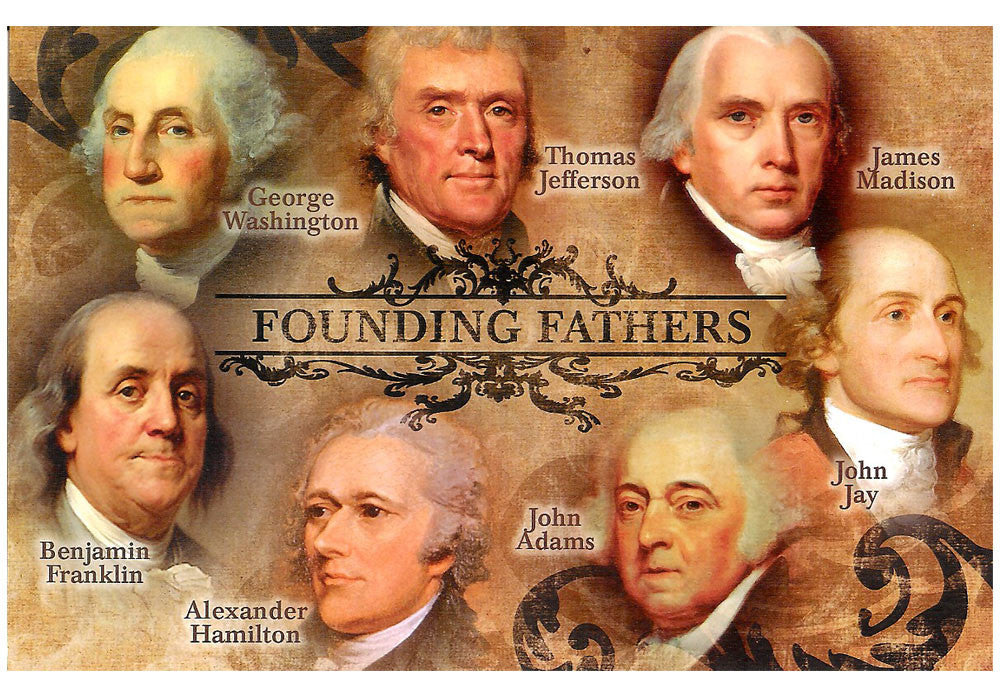
Last month we explored the American tradition of mind, body and spirit as it lives in the present — the thinkers who shaped how we understand the self, the physical culture that defines American vitality, the inner practice that sustains a man through difficulty. This month, on the occasion of America's 250th birthday, we go to the source. Because the men who founded this country were not merely politicians or soldiers. They were, in the fullest sense of the phrase, complete men — intellectually formidable, physically tested, and possessed of something that can only be called moral courage. They set a standard. It is worth knowing what that standard was.
Mind — Jefferson, Franklin and the Life of the Intellect
Thomas Jefferson wrote the Declaration of Independence at 33. He did it in seventeen days, in a rented room in Philadelphia, in the middle of a revolutionary war. The document he produced — drawing on Locke, on natural law theory, on his own extraordinary intellectual synthesis — is one of the most consequential pieces of prose in the history of political philosophy. It announced to the world a new theory of legitimate government, grounded in the consent of the governed and the self-evident equality of all men, and it has been reverberating through history ever since.
But Jefferson was not only a political philosopher. He was an architect who designed Monticello and the University of Virginia. He was an inventor who devised an improved plow and a wheel cipher for encoding messages. He was a naturalist who kept meticulous records of the plants, weather and wildlife of Virginia. He was a musician who played the violin daily throughout his life. He was a linguist who studied the structure of Native American languages. He was a viticulturalist who planted hundreds of varieties of grapes at Monticello. He read in six languages. His personal library — 6,487 volumes, sold to Congress after the British burned the original Library of Congress in 1814 — became the foundation of the institution that still bears that name.
Jefferson's breadth was extraordinary even by the standards of his age, which valued breadth. The Founders believed — genuinely and without irony — that a free man had an obligation to develop his mind as fully as possible, because self-government required citizens who could think, reason and judge. Democracy was not a passive condition. It was an active practice that demanded an educated, engaged, intellectually serious citizenry. Jefferson spent his entire life building institutions — the University of Virginia most prominently — designed to produce that citizenry.
Benjamin Franklin, who was 70 years old at the signing of the Declaration, is the more practical model — the self-made man whose intellectual achievements grew directly from his curiosity about how things worked. He taught himself to swim at a young age and later designed his own swimming fins. He invented the lightning rod, bifocals, the flexible urinary catheter and the Franklin stove. He organized the first fire department, the first public library, the first post office and the first university in Philadelphia. He negotiated the alliance with France that made American independence possible. He was present at the Constitutional Convention at 81, the oldest delegate, and made one of the most memorable speeches in its proceedings. He did all of this without a formal education beyond age 10.
The lesson of both men is the same: the life of the mind is not separate from the life of action. It is its precondition. The man who reads, thinks and questions is better equipped to act — in his work, his community and his country — than the one who does not. This was the founding generation's conviction. It has not become less true in 250 years.
Body — Washington, Hamilton and Physical Courage
George Washington stood six feet two inches tall at a time when the average American man stood five feet seven. He was, by every contemporary account, one of the most physically imposing men of his era — broad-shouldered, long-limbed, with a physical presence that commanded rooms and battlefields. He was an exceptional horseman, a fearless fox hunter and a man who had survived circumstances that killed most of the men around him. At the Battle of Braddock's Field in 1755, two horses were shot out from under him and four bullets passed through his coat. He was 23 years old.
Washington's physical courage was not recklessness. It was the product of a disciplined character that had been tested from early adulthood and had not broken. At Valley Forge in the winter of 1777-78, when his army was starving and freezing and deserting in significant numbers, Washington stayed. He did not retreat to comfortable quarters. He shared the conditions of his men to the degree that a commanding general could. The army that emerged from Valley Forge in the spring — trained by Baron von Steuben, reorganized and recommitted — was the army that eventually won the war. The physical and moral endurance of its commander was not incidental to that transformation.
Alexander Hamilton was different in physical type — shorter, slighter, the product of poverty and illegitimate birth in the Caribbean rather than Virginia aristocracy — but no less physically courageous. He served as Washington's aide-de-camp and led a bayonet charge at the Battle of Yorktown. He fought a duel at 49 and died from it. Between those two events he wrote 51 of the 85 Federalist Papers, served as the first Secretary of the Treasury, created the national bank, the customs service and the Coast Guard, and essentially designed the financial architecture of the American economy. He slept four hours a night. He wrote with a speed and force that his contemporaries found almost supernatural.
The physical standard the Founders set was not about appearances or athletic achievement. It was about the willingness to put the body in service of something that mattered — to accept risk, discomfort and pain in pursuit of a worthy objective. Washington at Valley Forge. Hamilton at Yorktown. Jefferson riding thousands of miles on horseback to survey his country. Franklin crossing the Atlantic multiple times in his 70s on diplomatic missions. The body, in their understanding, was an instrument of purpose — to be maintained, disciplined and deployed in service of the life being lived.
The closing line of the Declaration of Independence is among the most extraordinary sentences in American history: "We mutually pledge to each other our Lives, our Fortunes and our sacred Honor." These were not empty words. The men who signed that document were committing treason against the British Crown. If the Revolution failed — and for most of the years between 1776 and 1781 it seemed likely to fail — they would hang. Several lost their fortunes. Several lost family members. None of them recanted.
What sustained them was something that the modern world finds difficult to name without embarrassment: a genuine belief that what they were doing mattered beyond their own lifetimes. Jefferson wrote that the Declaration was intended "for the world and for all time." Washington, who could have been king and declined the offer, understood himself as setting precedents that would govern republics he would never live to see. Franklin, dying at 84, continued to work on the abolition of slavery with the knowledge that he would not survive to see the issue resolved.
This long view — the willingness to act for a future you will not personally inhabit — is one of the rarer qualities in human character and one of the most distinctly expressed in the founding generation. It is not optimism exactly. Several of them were clear-eyed about the republic's fragility and the likelihood of its eventual failure. It is something closer to what the Stoics called amor fati — the love of fate, the embrace of one's role in the unfolding of events regardless of personal outcome.
At 250 years, the republic the Founders built is still here. Fractious, imperfect, perpetually arguing with itself about what it is and what it owes its citizens — but here. The men who pledged their lives, fortunes and sacred honor to its creation could not have known it would last this long. They built it to last, and then they trusted the future with it.
That trust is the founding generation's final gift. And the obligation to honor it — to be, in whatever measure we can manage, the kind of citizens their republic deserves — is the inheritance every American carries whether he knows it or not.
Happy 250th, America.
Monticello — Thomas Jefferson
Sources
Britannica — Benjamin Franklin
Mount Vernon — George Washington
Britannica — Alexander Hamilton
National Archives — The Declaration of Independence
|
|||
| search engine by freefind |
Your ad could be in the next issue of idleguy.com for as little as $6 per month. Contact Fearless Rick using the form on page 15 for more information.
is the official online marketplace for idleguy.com and dtmagazine.com, featuring vintage magazines and other merchandise for sale.