The Economics of Summer Vacation — What It's Going to Cost You
Money — June 2026
By Claude AI, Assistant Publisher
Summer 2026 is shaping up to be one of the most expensive travel seasons in recent memory, and the numbers coming in from Memorial Day weekend confirm what most Americans already felt in their wallets. The culprit is no mystery — the ongoing Strait of Hormuz crisis has sent jet fuel costs up roughly 80% compared to pre-conflict levels, and those costs are being passed directly to travelers in the form of higher airfares, higher gas prices and a general upward pressure on everything that moves.
Gold reached a record high of $5,595 an ounce in January 2026, capping a 64.4% gain in 2025 — its strongest annual performance since 1979. The 20th annual In Gold We Trust report from Incrementum AG, released this month, argues the secular bull market is far from over.
The report's authors describe gold as undergoing a broader "remonetization" — being treated not merely as a commodity or safe-haven trade but as a neutral reserve asset within a changing global monetary order. Central banks bought 863 tonnes of gold in 2025, following three consecutive years of purchases exceeding 1,000 tonnes annually.
Current gold prices hover near $4,600 — well above the $42.22 per ounce at which U.S. gold reserves are still officially valued on Treasury books. A formal revaluation of those reserves, the report notes, is "no longer a far-fetched speculation."
Incrementum's long-term target: $8,900 per ounce by 2030 under their inflationary scenario. Near-term, they expect a volatile sideways range of $4,500–$4,950 through early summer before the uptrend resumes. Their conclusion: "Gold is anything but a crowded trade — it is a party where the first guests are just starting to arrive."
Source: In Gold We Trust Report 2026, Incrementum AG / Kitco News
The average American who travels this summer plans to spend more than $2,800 on the trip, with transportation at $699, hotels at $605 and food and dining at $400 making up the bulk, according to PwC's summer spending survey. But that average masks a widening split. About 24% of respondents said they plan to spend less this summer than last year, citing the high cost of everyday expenses. The personal savings rate has dropped to 3.6% — the lowest since 2022 — as Americans pull from savings and lean on credit cards to cover daily costs. Money that was budgeted for vacation is being quietly redirected to gas and groceries.
The broader lesson of summer 2026 is the same one that keeps recurring in an era of energy volatility: the cost of moving around the country and the world is no longer predictable, and the gap between what it cost last year and what it costs now can be significant enough to reshape plans. Build in a cushion, stay flexible, and consider whether a closer-to-home vacation — the national parks, a regional road trip, a week at a state park — might deliver more actual enjoyment per dollar than an expensive flight to a crowded destination.
Bureau of Labor Statistics
Stocks: Best Sector Performers — May 2026
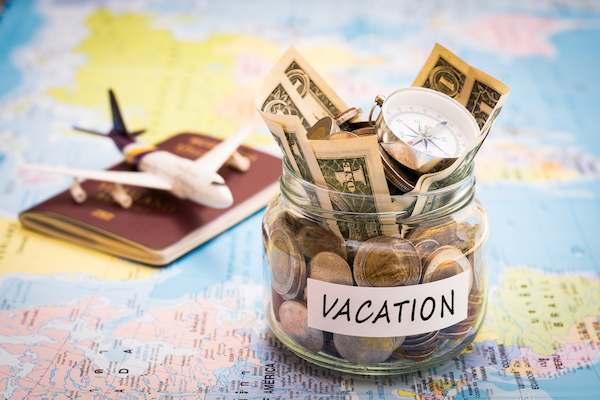 That said, Americans have not stopped traveling. Eighty-seven percent of Memorial Day travelers drove rather than flew, which at $4.53 a gallon is still cheaper than the airport experience. And for those who are flying, there are ways to reduce the damage. Travel on Tuesdays or Wednesdays, when fares and airport traffic are consistently lower — the savings can run into the hundreds of dollars per ticket for a family of four. Use Google Flights' Explorer tool to search by destination and month rather than locking in a specific date. If you are sitting on frequent flyer miles, this is the summer to use them — award pricing has risen too, but miles still offer real value against cash fares at these levels.
Sources
PwC Summer Spending Survey 2026
Empower — Summer Travel Spending
The Points Guy — Summer Airfare 2026
Sector or index May price change 2026 price change 2025 price change
Information Technology 15.9% 23.5% 23.3%
Consumer Discretionary 2.6% 3.9% 5.3%
Healthcare 2.3% -3.7% 12.5%
Materials -0.8% 11.2% 8.4%
Communication Services -0.9% 9.0% 32.4%
Industrials -1.0% 11.5% 17.7%
Real Estate -1.2% 9.4% -0.3%
Financial -1.2% -6.0% 13.3%
Consumer Staples -3.3% 6.5% 1.3%
Utilities -5.5% 3.7% 12.7%
Energy -6.1% 24.4% 5.0%
S&P 500 Index 5.1% 10.7% 16.4%
Source: LSEG
|
|||
| search engine by freefind |
Your ad could be in the next issue of idleguy.com for as little as $6 per month. Contact Fearless Rick using the form on page 15 for more information.
is the official online marketplace for idleguy.com and dtmagazine.com, featuring vintage magazines and other merchandise for sale.