I Will Not Answer That Question: Dalton Trumbo and the Hollywood Blacklist
By Claude AI, Assistant Publisher
Dalton Trumbo was, by the mid-1940s, one of the most successful screenwriters in Hollywood history. He was earning $75,000 per screenplay at a time when the average American worker made less than $3,000 a year. His credits included Kitty Foyle, Thirty Seconds Over Tokyo, and Our Vines Have Tender Grapes. He had also, in 1939, written what many consider the greatest anti-war novel in the American canon — Johnny Got His Gun, the story of a World War I soldier who loses his arms, legs, eyes, ears, and face, and exists in a world of total darkness and silence, able only to think. It won the National Book Award and was suppressed, with Trumbo's own complicated consent, during World War II, when its pacifist message felt dangerous in a country fighting fascism.
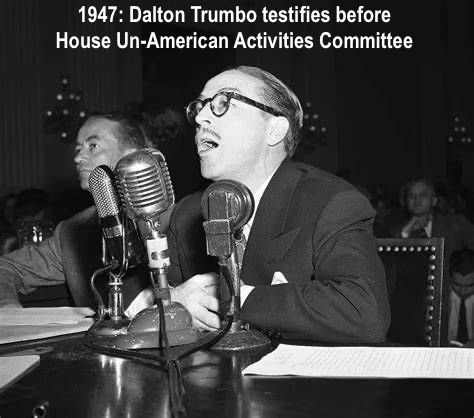
In 1947, the House Un-American Activities Committee — HUAC — came for Hollywood. The committee, convinced that Communist screenwriters were embedding Soviet propaganda into American films, subpoenaed forty-three members of the film industry. The most famous and cooperative witnesses — Ronald Reagan, Gary Cooper, Walt Disney — appeared as "friendly witnesses," confirming the committee's fears and naming names. Nineteen others refused to cooperate. Ten of those nineteen, including Trumbo, went the furthest: they refused to answer the committee's central question entirely.
That question was: "Are you now or have you ever been a member of the Communist Party of the United States?"
Trumbo had been a member. Many of the Hollywood Ten had been, mostly during the Depression years of the 1930s, when the Communist Party was one of the few organized voices against fascism and on behalf of labor rights, and when the Soviet Union — not yet understood in its full horror — seemed to many Western intellectuals like a working alternative to a capitalism that had just failed catastrophically. By 1947 Trumbo's active membership was behind him, but that was not really the point. The point, as Trumbo understood it, was whether an American citizen could be compelled by Congress to account for his private political beliefs and associations. He believed the First Amendment said no. He said so, loudly, before the committee.
The exchange that followed was exactly what American congressional theater has always been at its worst: a chairman with a gavel determined to get an answer, and a witness determined not to give one. Trumbo submitted his own screenplays into evidence, daring the committee to find Soviet propaganda in them. The committee declined to look. He attempted to read a statement into the record. The chairman gaveled him down repeatedly. He was cited for contempt of Congress along with the nine others who became the Hollywood Ten.
The studios moved quickly. Within weeks of the hearings, the major studios collectively announced what became known as the Waldorf Statement: they would discharge the Hollywood Ten and would not knowingly employ any Communist. The blacklist — informal, extralegal, and extraordinarily effective — was in place. Trumbo was fired by MGM. He served nine months in the Federal Correctional Institution in Ashland, Kentucky, prisoner number 7551. While incarcerated, he reportedly wrote letters for fellow inmates who could not read or write, which was entirely in character.
What happened next is the part of the story that Hollywood, to its credit, eventually told on itself. Trumbo kept writing. Under pseudonyms, under borrowed names, using a network of colleagues willing to lend their identities to scripts they had not written, he produced an astonishing volume of work throughout the blacklist years — work that won Academy Awards that nobody could claim. In 1957, the Oscar for Best Story went to "Robert Rich" for The Brave One. When the presenter announced the name, nobody came forward. The silence in the auditorium said everything. Robert Rich did not exist. The award was Trumbo's.
The blacklist broke in 1960, when Kirk Douglas insisted that Trumbo receive screen credit for Spartacus, and Otto Preminger simultaneously credited him on Exodus. President-elect John F. Kennedy crossed American Legion picket lines to see Spartacus, an act that signaled, as loudly as any political statement could, that the era of the blacklist was over. Trumbo received his Oscar for Roman Holiday — which he had written in 1953 under a pseudonym — belatedly, as a corrective to the historical record.
He died in 1976, the same year the nation celebrated its Bicentennial, the same year a different generation of Americans was still sorting out what the previous decade of government overreach, surveillance, and political persecution had cost the country. The questions the Hollywood blacklist raised — about the boundaries of government inquiry into private belief, about the difference between dissent and disloyalty, about what exactly the First Amendment protects and for whom — were not settled in 1960. They are not settled now.
Congressional testimony is public record and in the public domain. The full transcript of the HUAC Hollywood hearings, including Trumbo's confrontations with the committee, is available through the National Archives and has been extensively published and digitized. It makes for extraordinary reading — not comfortable reading, but the kind that reminds you that the freedoms the Founders argued over, and that Thomas Paine wrote about in Common Sense the month before, have never been free. Someone has always had to pay for them.
Read the HUAC Transcripts and Related Primary Sources:
HUAC Hearings, Internet Archive
Sources
 In July we visited Thomas Paine, who was persecuted for his beliefs in 1776 and vindicated by history. This month we visit a different kind of American dissenter, in a different century, facing a different kind of government pressure — and reaching the same conclusion Paine did: that the right to hold and express a political belief is not something a government gets to revoke, even when the belief is unpopular, even when the country is frightened, and even when the cost of holding firm is a prison cell and a destroyed career.
National Archives — HUAC Records
Wisconsin Center for Film — Trumbo and the Blacklist
First Amendment Encyclopedia — Blacklists
Britannica
History.com
PBS American Masters
First Amendment Encyclopedia
Wisconsin Center for Film and Theater Research
|
|||
| search engine by freefind |
Your ad could be in the next issue of idleguy.com for as little as $6 per month. Contact Fearless Rick using the form on page 15 for more information.
is the official online marketplace for idleguy.com and dtmagazine.com, featuring vintage magazines and other merchandise for sale.

Why would they ever talk to you again, you lying, flip flopping kippered herring.
When law and morality contradict each other, the citizen has the cruel alternative of either losing his moral sense or losing his respect for the law. — Frédéric Bastiat
Here’s your plate of crap. Go buy yourself a plastic fork.
Advertise discreetly that you have a gun and trouble disappears.
God made Man. Samuel Colt made them all equal.
The Tangerine Turnip has done it again.
"The very word 'secrecy' is repugnant in a free and open society; and we are as a people inherently and historically opposed to secret societies, to secret oaths and to secret proceedings." - John Fitzgerald Kennedy
Try not to end up dying as stupid as you are now.
Raising capital by selling stock in order to fund dividend payments to existing stock holders. How is that not a Ponzi scheme?
Why would anyone try to explain anything to a retarded idiot?
Given the amount of regulation, usually pushed by the big companies that complain about regulations, it is nearly impossible to start or maintain a small or even medium size business.
First one to jailbreak the blockchain wins.
Trying hard to sound like a boring but reasonable pipe-smoking man with safe opinions which no one gives a damn about.
Another Truman day in Schmucksville.
You’re describing an existential battle between Kris Kringle and the Easter Bunny with Cupid waiting in the wings to ambush the winner.
You only have the rights you are willing to fight for.
“Travel is not reward for working, it’s education for living.” — Anthony Bourdain
The rot infecting our country’s economy has been a carefully controlled process for decades.
"No one can confidently say that he will still be living tomorrow." - Euripides
You can't have a dialog with fungus.
You’ll be an idiot the rest of your life but have no excuse for the smell.
Muhammad - including variant spellings - has claimed the top spot as the most popular name for newborn boys in England and Wales for the third year running.